
There is a good chance you’re not getting everything you could from your VA.
And I’m not talking about whether they’re completing their tasks on time or keeping up with your to-do list. I’m talking about something that often gets overlooked when a business owner hires a virtual assistant: the experience, knowledge, and perspective that person brings to the table.
A good VA can become much more than the person who checks things off your list. As they get to know your business, they learn how you work, understand your clients, become familiar with your systems, and start to see patterns. They begin to know what typically happens next, which details tend to get missed, and where a process could work better.
But that only becomes truly valuable when you include them in the conversation.
Your VA May Know More Than You Realize
One of the things I’ve noticed throughout my career is that business owners often hire a VA for a particular purpose and never realize how much additional experience that person brings with them.
I’ve experienced this myself. I’ve done so many different things over the years that a client might hire me because they need help with their email marketing, website, or administrative work without realizing that I’ve also built courses on multiple platforms, including Kajabi, created systems, managed launches, solved technology problems, and worked on countless other pieces of online businesses.
Unless we talk about those things, they may never know.
And sometimes the problem isn’t that a VA hasn’t communicated their capabilities. The VA simply doesn’t know what’s coming.
A client may decide to build a course, change email marketing platforms, launch a new offer, or completely change a process. They might make that decision while talking with a coach or colleague. Someone recommends a consultant, and suddenly that consultant is brought in to help solve the problem.
By the time the VA hears about it, the decision has already been made.
That’s why I believe the relationship between a business owner and a VA needs to go beyond task management. Your VA needs to be included in the planning conversation.
A Real-Life Example
I saw this play out with a client who used texting as the primary way of communicating with her team. Everything went through text messages, including instructions, questions, updates, and conversations between team members.
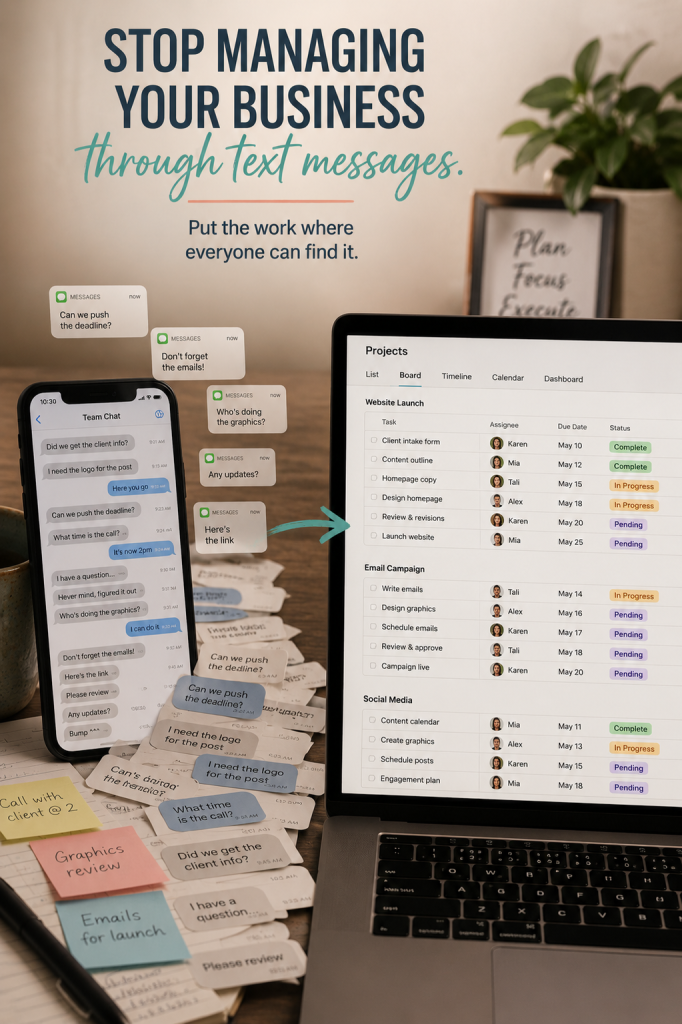
As you can imagine, the text threads became incredibly long. Information was difficult to find, things occasionally fell through the cracks, and team members sometimes had to search through old conversations to find the information they needed to do their jobs.
I suggested moving the team’s communication into a project management system such as Asana. Instead of having important information scattered throughout text messages, we could keep the communication attached to the appropriate job or project. Everyone would know what needed to be done, who was responsible for it, and what the deadline was.
The client didn’t take my recommendation.
Later, she hired a consultant who recommended the same thing.
So, after spending thousands of dollars on a consultant, we ended up implementing the solution I had originally suggested.
Once the decision was made, I set up Asana and trained the team to use it. The team loved it. They knew what they needed to do and when they needed to do it. They didn’t have to search through text threads to find information, and the work moved much more efficiently.
The client took a little longer to fully adapt, but eventually she saw the value too.
I’m not telling this story because I want to say, “See? I told you so.” In fact, that’s not really the point.
The point is that I already understood the business well enough to recognize the problem and recommend a solution. The value wasn’t simply knowing how to use Asana. It was understanding what was happening inside the business and recognizing that the existing system was creating unnecessary problems.
That’s the kind of experience that can be easy to overlook when you think of your VA as someone who simply completes tasks.
Business Owners Often Know the Destination, But Not the Road
This is where I think an experienced VA can become particularly valuable.
A business owner may have a big-picture goal. Their coach may have told them, “You need to create a course,” or “You need to launch this new offer,” or “You need to improve your email marketing.”
That’s the destination.
But getting there involves dozens of smaller decisions and steps.
- What platform will you use?
- What needs to be created?
- What systems need to be updated?
- What emails need to be written?
- What needs to happen on the website?
- What does the client experience look like?
- What needs to be tested?
- Who is responsible for each piece?
- What needs to happen first?
The business owner may not know all of those steps, and they shouldn’t necessarily have to.
That’s where a VA who understands the business can help.
When I’m included in the planning, I can start thinking ahead. I can identify what needs to be put in place before the next step arrives. I can recognize when something is missing and ask about it before it becomes a problem.
I’m not replacing the business owner’s vision or their coach’s expertise. I’m helping turn that vision into something that can actually be implemented.
This Isn't Entirely the Client's Fault
I don’t want to put all of the responsibility on business owners, because VAs have a role here too.
We can do a better job of communicating what we’re capable of.
If a client doesn’t know that I’ve built courses on Kajabi, for example, they can’t reasonably be expected to ask me for help with their Kajabi course.
VAs need to talk about their experience and make their capabilities known. We also need to ask questions and be proactive rather than waiting for clients to hand us tasks.
But there’s a limit to how proactive we can be when we don’t know what’s being planned.
That’s why I think the responsibility really belongs to both sides.
Business owners need to bring their VA into the planning process, and VAs need to make themselves available as a source of experience and ideas.
Start With a Six-Month Conversation
One of the simplest things a business owner can do is sit down with their VA talk about the next six months. Talk about the next year. Share the big goals, even if the details aren’t worked out yet.
Then ask your VA how they think they can contribute.
You might discover that they have experience with something you’re considering. They may see a potential problem you haven’t thought about. They may know that a system needs to be updated before you launch something new.
And before you automatically hire another consultant or bring another team member into the business, ask your VA whether it’s something they can help with.

That doesn’t mean your VA will always have the answer. Sometimes you absolutely need a specialist, consultant, coach, designer, developer, or another professional.
But asking the question costs you nothing.
And you may discover that the person you already trust has more experience than you realized.
Don't Forget to Ask About Their Experience
There’s another simple conversation that is worth having periodically: ask your VA what they’ve been doing, what they’ve learned, and what areas they have experience in that you may not know about.
A lot of that information probably came up during the initial consultation when you hired them. But how often have you actually talked about it since?
People grow. Skills change. Experience accumulates.
Your VA may have learned something new, taken on a project for another client, or developed an expertise that could be useful to your business.
Don’t assume you know everything your VA can do just because you hired them for a specific role.
Give Your VA Space to Think
I always do my best work, whether I’m completing a specific task or working with a client as a partner. But there is a difference in what I can contribute when I’m included in the bigger picture.
When I know what’s coming, I can anticipate the next steps. I can start putting systems in place before they’re needed. I can recognize when something is missing. I can ask questions that might prevent a problem later.
That doesn’t happen when I’m only given a task after all of the decisions have already been made.
If you want your VA to bring more experience and insight to your business, you have to give them the opportunity and space to do that.
Ask what they think. Ask what they recommend. Tell them what you’re planning. Listen when they point something out.
And sometimes, just ask:
“What would you do?”
You may be surprised by the answer.
You May Already Have More Support Than You Realize
The next time you find yourself researching consultants, coaches, platforms, or specialists to solve a problem in your business, pause for a minute.
Before you start looking outside your existing team, ask the person who already knows your business:
“Have you done this before?”
“What do you recommend?”
“How would you approach this?”
Maybe they don’t have the answer. That’s okay. You may still need to bring in someone with specialized expertise.
But maybe they do.
Maybe they’ve already solved a similar problem. Maybe they’ve seen the issue coming. Maybe they know exactly what needs to happen next.
You won’t know unless you ask.
The best VA relationships aren’t built around a never-ending list of tasks. They grow into partnerships where the VA understands the business well enough to anticipate, recommend, question, and help prepare for what’s coming.
If you already have someone like that on your team, don’t overlook what you’ve got.
You may not need another person telling you what to do. You may simply need to start asking your VA what they recommend.

